
Los Angeles Volunteer Firefighters: Unpaid, Not Unprofessional
The city’s fire service began with volunteer companies. Held to professional standards, they still have a place in it.
I grew up in a fire station. Both of my grandfathers, my grandmother and my mother all ran calls with the volunteer fire department, and when the tones dropped, I went where they went. I learned early that a fire company is not defined by its budget or its payroll. It is defined by who shows up, and whether they are ready when they do.
Volunteer should describe how a firefighter is compensated, not how seriously the work is taken.
A City of Fire Companies
Los Angeles has always had a complicated relationship with fire.
Los Angeles is a city stitched together from former municipalities, rural communities, canyon neighborhoods, industrial districts, ports, rail corridors and vast stretches of wildland-urban interface. Fire protection here has never been a simple matter of drawing a line on a map and assuming one institution, one station or one system could answer every possible need.
For much of the city’s history, it did not work that way at all.
Los Angeles was built, in part, by people who saw problems in their communities and organized themselves to solve them. Fire protection was no exception. Long before the modern Los Angeles Fire Department became one of the largest professional fire departments in the country, Los Angeles relied heavily on volunteer firefighters. The city’s early fire service was not a single centralized organization resembling today’s department. It was a collection of companies, each with its own members, identity, equipment and territory of particular concern.
Thirty-Eights Engine Company No. 1, Confidence Engine Company No. 2, Vigilance Hook & Ladder, Park Hose Company, East Los Angeles Hose Company and Morris Vineyard Hose Company were among the organizations that protected Los Angeles during the nineteenth century. As the city expanded, additional companies were formed because residents and civic leaders believed additional fire protection was needed.
That history is important because it reveals something that has largely disappeared from modern conversations about public safety: the existence of an established fire service did not automatically mean there was no place for another one.
Companies could overlap, and different organizations could protect different neighborhoods, institutions or risks. The question was rarely who had exclusive authority to care about a problem. It was more practical: “What resources do we have, and how do we protect this community?”
One of the most interesting examples was Southern Pacific Company No. 1. In the early 1880s, Southern Pacific Railroad employees organized their own firefighting company around the railroad’s Los Angeles facilities. The city already had organized fire protection. The Southern Pacific company was not created because nobody else existed. Nor was it simply another unit of the city’s volunteer fire department. Historical accounts describe it as a separate company that nevertheless worked alongside the existing Los Angeles firefighters and provided meaningful protection around the railroad district.
It shows that Los Angeles once accepted something that now seems oddly controversial: additional organized fire protection does not necessarily undermine existing fire protection, and sometimes it strengthens it.
The creation of a paid Los Angeles Fire Department in 1886 certainly represented progress. A rapidly growing city needed greater consistency, professional staffing, stronger organization and more reliable equipment. But even that transition was not the clean break between “volunteer” and “professional” that modern retellings sometimes suggest.
The new paid department began with a relatively small cadre of salaried firefighters supported by reserve and on-call personnel. Contemporary descriptions of the new system also contemplated volunteer hose companies continuing within the broader structure. The move toward a professional department was therefore not originally based on the proposition that paid firefighters and volunteers were fundamentally incompatible. It was based on the proposition that Los Angeles needed more organization and more dependable capability.
Professionalization should mean higher standards: better training, stronger accountability, improved equipment, reliable communications, defined command structures and clear responsibility. It should not mean that every form of citizen-organized fire protection becomes illegitimate.
The Towns That Became Los Angeles
The same pattern can be seen across communities that are now considered ordinary parts of Los Angeles.
Wilmington had volunteer firefighters before becoming part of the City of Los Angeles. San Pedro developed its own volunteer fire organizations. Hollywood relied on volunteer firefighters before annexation. Venice operated its own fire department before joining Los Angeles. Other communities throughout the region developed local fire organizations based on local conditions and local need.
These communities became Los Angeles, and their fire departments became part of the city’s fire-service lineage through annexation, consolidation or replacement. The modern map of Los Angeles literally contains communities where residents once organized their own fire protection because that was what the circumstances required.
That is why the argument that volunteer fire departments somehow do not belong in Los Angeles deserves more scrutiny than it usually gets.
There is a tendency in large cities to treat public safety as something that government provides and residents consume. You pay taxes, you call 911, and trained professionals arrive. That system works, and its career firefighters are highly capable.
But a professional fire service does not have to be an exclusive one, and its existence does not mean qualified firefighters have nowhere else to serve.
What Makes a Department Professional
So the useful question is how volunteer fire departments should be organized, and that starts with standards.
Nobody should be trying to recreate 1880s firefighting.
Training should be rigorous. Insurance should be appropriate. Communications should be reliable. Members should understand the Incident Command System. Organizations should know the limits of their legal authority. Leadership should be accountable. Relationships with neighboring agencies should be built before an emergency, not improvised in the middle of one. Meeting those requirements is exactly what makes a volunteer department professional.
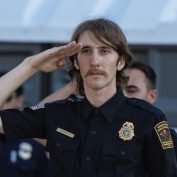
This isn’t an abstract argument. Southern California Wildfire Response is a volunteer wildland fire and all-hazard emergency response department, and this is the model it is working to prove can succeed in modern Los Angeles: professional firefighters who forgo a paycheck, not standards.
The argument for volunteer fire departments is especially compelling in places where geography, weather and population make complete coverage extraordinarily difficult. Los Angeles contains steep canyons, winding roads, isolated ridgelines, dense neighborhoods pressed against wildland vegetation and communities where a small fire can become a major incident with frightening speed.
No public agency can place a firefighter on every road, every hillside or every block. That is not a criticism of career departments; it is geography.
The existence of career departments does not eliminate the value of additional trained firefighters who know their communities and local roads. Within their authority, they can stop a small fire before it becomes a large one, staff engines and patrol during extreme fire weather, and support evacuation, communications, logistics and rehab on larger incidents.
That is what a volunteer fire department provides, and it is the same thing any fire department provides: firefighters who are trained, equipped, insured, accountable and connected to a command structure before the emergency begins. The only difference is the paycheck.
A community that wants more fire protection, and is willing to meet fire-service standards to provide it, should have a legitimate path to building its own fire department.
Participation, not complaint, is the tradition that built Los Angeles.
Coordination, Not Exclusivity
There will always be people who say the existing system is sufficient and anything more is unnecessary. Los Angeles has heard that argument before, and the city kept growing anyway by adding companies, stations, apparatus, personnel and specialized capability. The fire service got stronger because people kept recognizing new needs and building ways to meet them, and that principle still applies now that the institutions are larger.
Of course, additional organizations must fit into a modern public safety environment. Emergency scenes cannot function if every organization acts independently, and the agency with legal responsibility for an incident has to be respected.
But coordination and exclusivity are not the same thing. A modern fire service can insist on clear command and high standards while still making room for trained people who do not draw a municipal paycheck. It can protect its jurisdiction without treating every outside organization as hostile, and it can tell irresponsible freelancing apart from disciplined volunteer service. That is a healthier model than total control or total exclusion.
In the strongest systems, career firefighters form the backbone and volunteer firefighters add capacity, each understanding its role.
Los Angeles has spent more than a century professionalizing its fire service, and that is worth celebrating. But as wildfire risk grows and communities push farther into the wildland-urban interface, the city needs more trained firefighters, paid and volunteer, not fewer, and institutions willing to see collaboration as a strength.
Los Angeles has never been built entirely from the top down. It was built by people who saw something missing and created it, and volunteer fire companies were part of that from the beginning. They still are.
Southern California Wildfire Response (SCWR) is a volunteer wildland fire and all-hazard emergency response department serving Los Angeles and neighboring counties. We exist to protect communities and close the gap between when disasters begin and when help arrives. Learn more at socalwildfire.org.
Stay informed when it matters most.
Wildfires don't wait — get preparedness guides, evacuation updates, and recovery resources from Southern California Wildfire Response delivered straight to your inbox.
No spam. Unsubscribe anytime. This site is protected by reCAPTCHA and the Google Privacy Policy and Terms of Service apply.